This blog article was written about five years ago when I was an avid cyclist and clearly hadn’t entered fatherhood. Unfortunately, the days of a 4-5 hour ride seem nothing but a distant memory, but alas the information below highlights just how different TID models can be implemented in the real world. These concepts and case study findings have relevance beyond cycling and can be applied across a multitude of endurance activities.
Stemming from Stephen Seiler’s and Craig Neale’s work investigating the effectiveness of the polarised training concept, I made a concerted effort to try and “polarise” my own cycling training. I knew this would be difficult to implement, as unlike most of the studies which have investigated the efficacy of the polarised model, the vast majority of my riding consists of bunch rides completed outdoors. When compared to very controlled laboratory based &/or ergo HIIT sessions, outdoor bunch rides are a far more difficult proposition to control as there are so many external factors which influence your power output and acute physiological response to the ride (i.e. temperature, wind, terrain and strength of the other rides in the bunch etc). However, given that I cycle as a hobby and do not possess the talent nor the aspiration to race at a high level, I really value the social side of cycling and as a result, will always opt for a group ride over solo ergo sessions.
For every single ride over the past 5 months (21 weeks to be exact) I have concurrently collected both power (via Stages power meter) and heart rate data to see whether a polarised model is practically feasible given the abovementioned limitations. If you have read the Seiler article review you would know that VT1 / LT1 (~80% HRmax) and VT2 / LT2 (~90% HRmax) are the two physiological turn points which distinguish low, moderate (threshold) and high intensity activity.
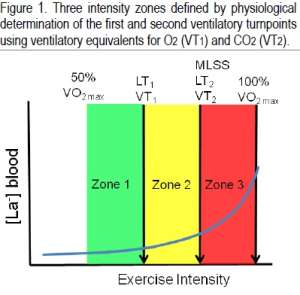
The first step in the process was to set-up my 3 training zones to distinguish exercise intensity. The percentage heart rate values for VT1 / LT1 and VT1 and LT2 were obtained from the Seiler & Kjerland (2010) and Neale et al (2012) papers.
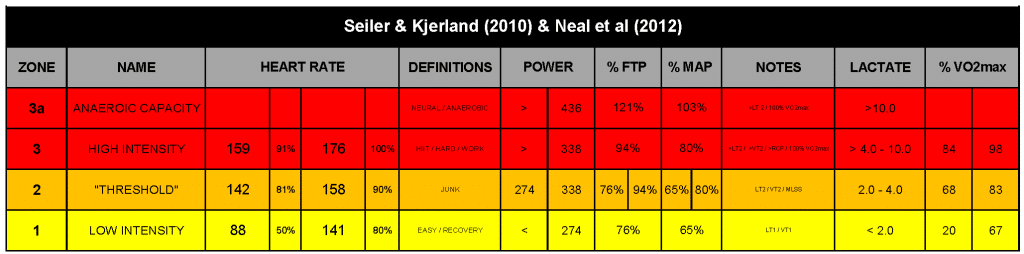
The figure above should be fairly self-explanatory and gives you an insight into the heart rate and power values that constitute an easy, moderate or hard session. For example, for my regular bunch ride on Beach Rd which for 20km is categorised as a “high intensity” session, I aim to spend as much time with my heart rate above 163 bpm and achieve a normalised power of greater than 338 watts. Conversely, if I was to complete an “easy” session I would aim to keep my heart rate below 144 bpm and normalised power below 274 watts.
Unlike the vast majority of training intensity distribution studies utilising cycling, I have concurrently collected both heart rate and power to identify which measure is more sensitive and accurate for quantifying training intensity distribution. Most of Seiler’s work has utilised heart rate to assess training intensity distribution, which obviously makes it easier to investigate different exercise modes. So, what does the training intensity distribution for my heart rate and power data look like over the 21 weeks?
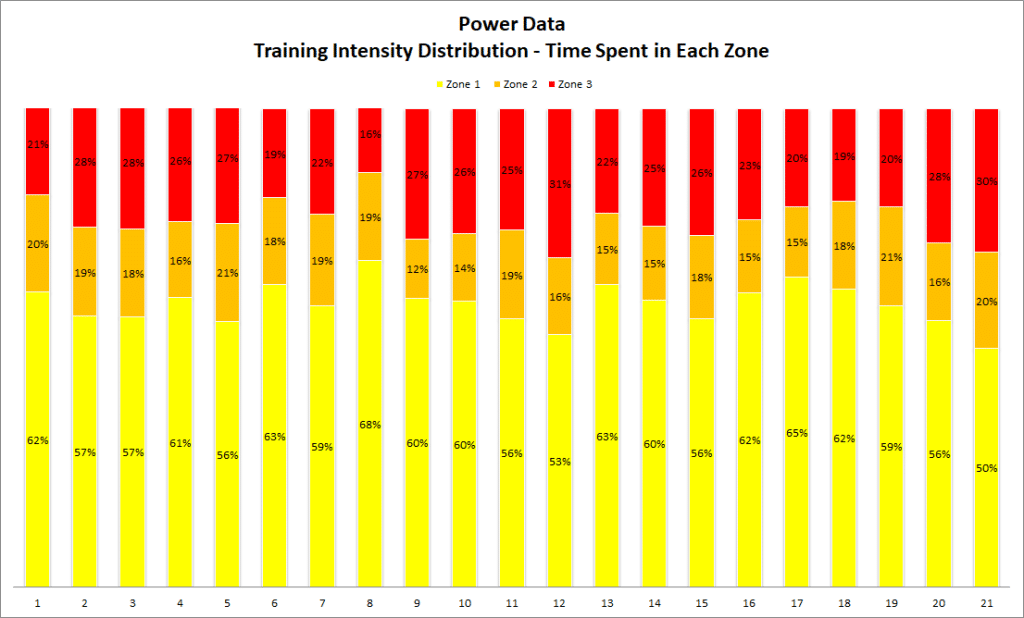
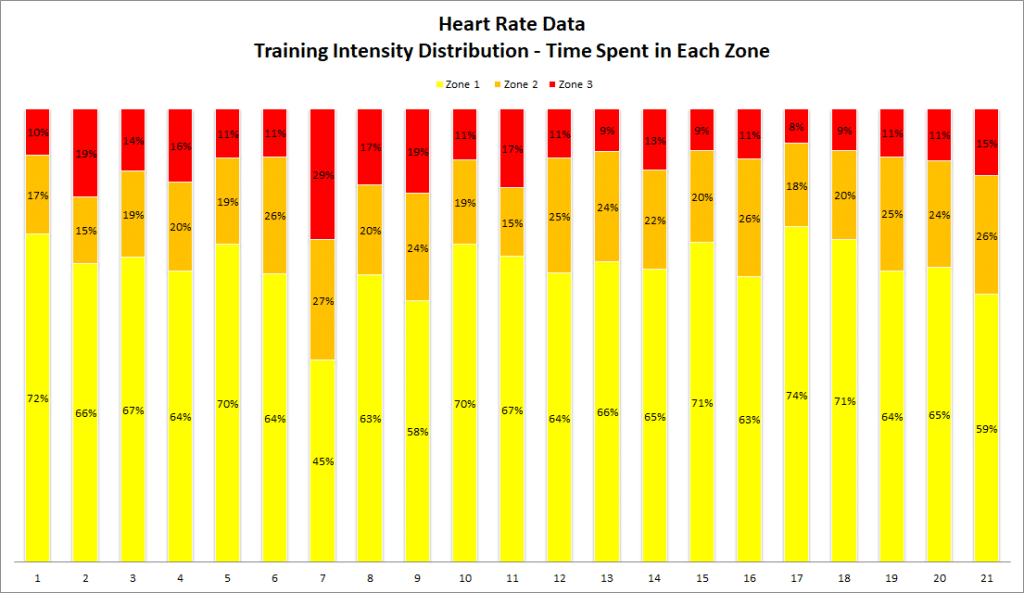
It is apparent from the graphs that I spend more time in zone 1 and zone 2 when looking at the heart rate data, whereas I spend more time in zone 3 when looking at the power data. However, it isn’t clear whether I have been successful in polarising my training utilising these graphs, rather I would need to look at the average time spent in each zone across the 21 weeks.
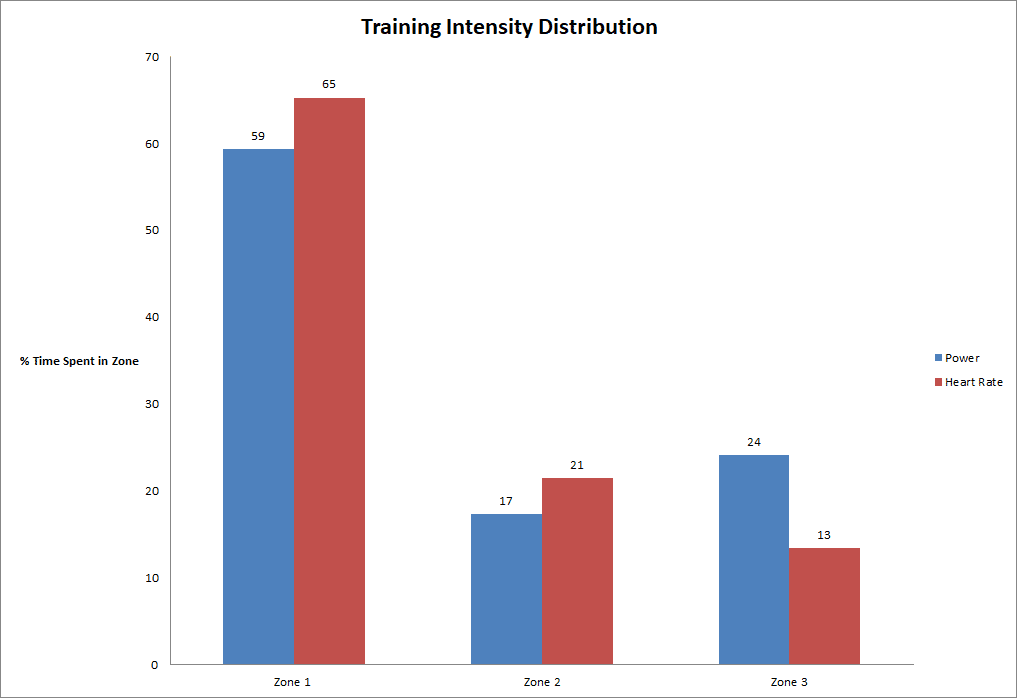
As you can see there is a disconnect between the heart rate and power data. If you just utilise the power data, it appears that I have been successful in implementing a polarised training approach, however, this polarised approach isn’t evident when looking at the heart rate data with 8% more time spent in zone 2 than the high intensity zone.
So which measure if more accurate? Over the next few weeks I will endeavour to add more context to this article utilising data from specific rides on varying terrains to highlight how this impacts heart rate, power and the training intensity distribution. Also, as I haven’t been able to source any other literature which has concurrently quantified training intensity distribution utilising both heart rate and power, I will discuss which measure is more valid and reliable when looking at quantifying training intensity.
As always, if you have any questions &/or feedback, please do not hesitate to contact me.